
Gemini 3.8 Flash solved 73 of 100 LIBERO-PRO start states, which are simulated robot arm tasks, with the Cerulion harness and 25 without, with the same budget and success check. LIBERO-PRO is a robot manipulation benchmark, and a start state is one of its tasks from one starting scene. Cerulion is an open-source robot runtime, and its harness gives an LLM tools to see and move the arm, plus the arm's calibration record. Same LLM, different harness, which matters when you choose a model or tool setup for a robot agent.
The experimental harness ships in Cerulion 2.1.0 as cerulion rcp --sim and drives a simulated arm, so agent builders can run it themselves with no robot and no GPU.
In short:
- Gemini 3.8 Flash with Cerulion solved 73 of 100 simulated LIBERO-PRO start states and GPT-6 Astra without it solved 71, statistically indistinguishable.
- Per solved start state in simulation, Gemini 3.8 Flash cost 6.67 USD without Cerulion and 0.48 USD with it, at list prices, partly from caching.
- On 100 simulated LIBERO-PRO start states, 12 of 16 models solved more with Cerulion, and the gain is established for 9 after Holm's correction.

Gemini 3.8 Flash solved 73 of 100 LIBERO-PRO start states with Cerulion and 25 without. In simulation, same 100 start states, same budget and success check, November 2026. Data: harness results package.
Can an LLM control a robot arm?
An LLM can control a simulated robot arm: Gemini 3.8 Flash solved 73 of 100 LIBERO-PRO start states with Cerulion and 25 without. That was the main test, named before any episode ran.
Here is one episode. Claude Opus 5.5 is asked to pick up a bowl and place it on the plate. It reads the task, looks through the robot's cameras, picks the bowl up and sets it down. The benchmark's checker scores the episode solved.
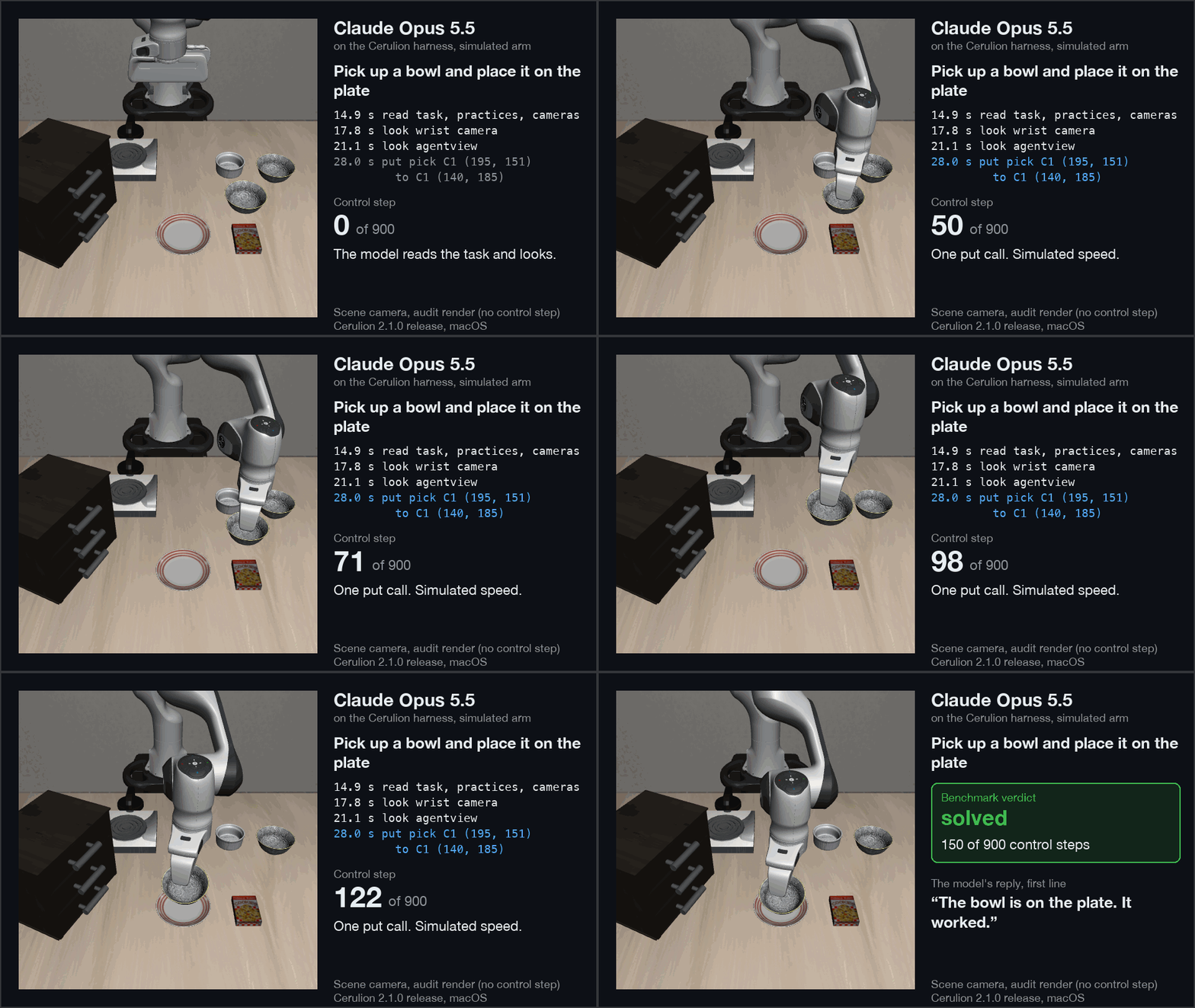
Claude Opus 5.5 on the simulated arm, on a task the harness was developed on. The last frame reads "Benchmark verdict: solved".
It was the model's third try at the task. The benchmark's checker scores what happened on the table, not what the model says happened.
How we measured
- Runs. 16 LLMs on the same 100 LIBERO-PRO start states, with Cerulion and without, one episode each at temperature 1.0.
- Where and when. In simulation, on Linux x86-64, November 2026.
- Budget. 80 model replies, one tool call each, and 900 control steps in both setups.
- Success. The benchmark's own checker decides. The model saying it succeeded does not count.
- Start states. 100 new ones, from 25 task rows the harness was developed on.
- Baseline. The published three-tool interface of arXiv:2610.30051, with its prompt word for word, runs in the same simulator, budget and checker, while the Cerulion run also reads the robot's calibration record.
- Statistics. An exact sign test per model counts the start states that one setup solved and the other did not. Holm's correction then sets a stricter pass mark for testing 16 models.
Every model, without and with Cerulion
The table lists start states solved, of 100, for every model in the chart's order. Look at the gap in each row. It is widest in the top half, where scores without Cerulion are lowest. The Reading column is the results package's verdict, and "established" means the gain passed the sign test after Holm's correction.
| Model | Without (of 100) | With (of 100) | Reading |
|---|---|---|---|
| GPT-6 Luna | 0 | 29 | Established |
| Claude Haiku 5.5 | 4 | 44 | Established |
| Grok 4.7 | 4 | 53 | Established |
| Claude Fable 5.2 | 10 | 84 | Established, against a content-filtered baseline |
| Claude Sonnet 5.5 | 16 | 51 | Established |
| Gemini 3.8 Flash | 25 | 73 | Established, the main test |
| Claude Opus 5.5 | 32 | 74 | Established |
| Gemini 4 Hydrogen | 39 | 79 | Established |
| GPT-6.1 Terra | 57 | 74 | Points up, not established, added late |
| GPT-6.1 Sol | 59 | 68 | No difference shown |
| GPT-6.2 Sol | 59 | 73 | Points up, not established |
| Gemini 4 Argon | 63 | 84 | Established |
| GPT-6 Astra | 71 | 70 | No difference shown |
| GPT-6.2 Astra | 81 | 77 | No difference shown |
| Gemini 4 Carbon | 82 | 76 | No difference shown |
| Gemini 4 Neon | 93 | 90 | No difference shown, added late |
On these 100 simulated start states, 12 of 16 models solved more with Cerulion, and the gain is established for 9 after Holm's correction. The 4 that did not are the 4 highest scorers without Cerulion, at 71 to 93 of 100, and each reads "no difference shown".
"Added late" means the model joined after other rows had been read. Without Cerulion, the provider's content filter ended 86 of Claude Fable 5.2's 100 episodes, so its gain is mostly against that filter.
In the main test, Gemini 3.8 Flash solved 52 start states with Cerulion that it did not solve without, against 4 the other way. An exact sign test on that split gives p = 1.10e-11, where p is the chance of a split at least this lopsided if the two setups were equal.
A stricter count goes further. A clean episode is solved inside the benchmark's published step limit, with no protocol break and no false success claim. On the same 100 simulated start states, Cerulion was ahead on clean episodes for 15 of 16 models, and that gain is established for 13. GPT-6 Astra shows the pattern, with 70 against 71 solved and 61 against 44 clean.
Every episode has a row in the harness results package, and recompute.py computes every figure again from those rows. To rerun a row against your own model, use the rerun route for evaluators.
What is LIBERO-PRO, and what is a start state?
LIBERO-PRO is a benchmark of simulated robot manipulation tasks, and a start state is one task from one starting scene. A task reads like "put the bowl on the stove". The 100 start states in this run come from 25 task rows, and each ran once in each setup.
What does a tool harness give the model, and does it change the result?
A tool harness lets the model look, act and check, and with Cerulion 12 of 16 models solved more simulated LIBERO-PRO start states.
Take the bowl task. The baseline is the three-tool interface of a published zero-shot study, arXiv:2610.30051: move_to, done and give_up. The model can move, then say it is done or give up. The interface is published and minimal, so anyone can read what the model was given.
The Cerulion harness gives the same model tools to look through the robot's cameras, move, touch, grasp and set down. Each call returns what the robot measured, namely where the hand stopped, what it felt, what a look shows, and which bound held a motion. So the model can look, act and look again. In the episode above, Claude Opus 5.5 set the bowl on the plate on its third try.
The harness also gives the model a record of the robot's own calibration, made by the robot's calibration episodes on development start states. The tools and the record were measured together, as one package. The cerulion rcp --sim command serves the tools over MCP, the Model Context Protocol that clients such as Claude Code use to call tools. The runtime under the harness is covered in our sister post on ROS 2 latency for large messages and on the latency benchmarks page.
The loop is shorter too. On the same 100 simulated start states, Gemini 3.8 Flash used 25.6 model replies per scored episode with Cerulion and 55.9 without.
Can a cheaper model with a harness do as well as a dearer one, and what does an episode cost?
Gemini 3.8 Flash with Cerulion solved 73 of 100 simulated start states for 0.35 USD an episode, and GPT-6 Astra without it solved 71 for 4.18 USD. The two scores are statistically indistinguishable (exact p = 0.864), the prices are list prices, and part of the cost gap is caching.
GPT-6 Astra without Cerulion cost about 12 times as much per episode as Gemini 3.8 Flash with it, on the same 100 start states.
GPT-6 Astra without Cerulion also took about 3 times as long as Gemini 3.8 Flash with it on the same 100 start states, 788 seconds against 259. That is mean wall time, endpoint retries included.
We named this pair before the grid ran, along with the same comparison against GPT-6.2 Astra. The results package reads both pairs as "no difference shown".
The decision this informs is whether to reach for a dearer model or a better tool setup for your robot agent. On this simulated benchmark, the tool setup put Gemini 3.8 Flash at a score statistically indistinguishable from GPT-6 Astra's.
Cost per solved start state
Per solved start state, Gemini 3.8 Flash cost 6.67 USD without Cerulion and 0.48 USD with it, at list prices on the same 100 simulated start states. Two things drive that gap. Each episode cost less, partly from caching, and more episodes ended solved.

Model cost per solved start state for 16 LLMs, without and with Cerulion, at list prices. In simulation, same 100 LIBERO-PRO start states, same budget and success check, November 2026. Data: harness results package.
The chart shows the same direction for every model that solved at least one start state without Cerulion.
How do I run an LLM on a simulated robot arm myself?
Cerulion 2.1.0 ships the simulated arm as cerulion rcp --sim: start it, connect an MCP client such as Claude Code, and ask for a task. For agent builders, the payoff is this post's claim on your own screen. You watch an LLM do a task and read the benchmark's verdict. No robot needed and no GPU, and one script installs the release.
You need macOS on Apple silicon or Linux on x86_64 or ARM64, git, curl, 5 GiB of disk space and a Cerulion account. You also need an MCP client whose model calls tools and reads images. On Ubuntu, also run sudo apt-get install libosmesa6 libegl1 libgl1 libglib2.0-0. The install is about 4 GB and takes minutes, once, and your model provider bills the model calls.
Install Cerulion and sign in:
curl -fsSL https://raw.githubusercontent.com/cerulion-inc/cerulion/main/tools/scripts/install.sh | sh
. "$HOME/.cerulion/env"
cerulion login
Start the simulator in one terminal and leave it running:
cerulion rcp --sim --http 127.0.0.1:8765It is ready when curl -fsS http://127.0.0.1:8765/health prints a line that starts with {"ok":true. Keep --http on loopback, because anyone who reaches it can start simulators on your machine and watch every episode.
In a second terminal, connect Claude Code and ask for a task:
claude mcp add --transport http cerulion-sim http://127.0.0.1:8765/mcp
claude "With cerulion-sim, put the bowl on the plate, and give me the link to watch the episode."
Open the link your model gives you, http://127.0.0.1:8765/view/<episode id>. The viewer shows the camera pictures, each tool call, the model's claim and the benchmark's verdict. A good run ends with this line in the viewer:
Benchmark verdict: solvedTrust the verdict, not the claim. Stop the simulator with Ctrl+C.
For evaluators: rerun a published start state
Evaluators get a separate route, the paired benchmark itself. Set OPENAI_BASE_URL to an OpenAI-compatible endpoint whose model takes tool calls and images, and OPENAI_API_KEY to its key. Then pick a start state from cells.csv in the harness results package:
cerulion rcp bench --model YOUR_MODEL --cell CELL_IDIt runs one episode with the harness and one without, and prints the benchmark's verdict for each.
If you plan to check or extend these results, star the Cerulion repository, where the harness code, every episode and recompute.py live.
Next step
If you are putting an LLM agent on your own robot, book a demo with the founders and work through your arm and your stack with us.